Rhizosphere 2026
An audiovisual exploration of life underground
April 24, 2026
5:00 p.m. & 7:00 p.m.
Life Underground
Tree trunks and canopies, plays of light and shadow, rustling leaves, birdsong, the crackling of foliage, insects, cool damp air, a musty smell, perhaps a mammal, and mushroom fruiting bodies pushing up through the forest floor. What we perceive as „the forest“ during a walk through the woods is largely limited to impressions above ground — shaped by what is visible, audible, and accessible.
But if we turn our attention and our imagined gaze downward, a hidden, dense, living system reveals itself beneath our feet, beneath the moss, needles, and leaves. Forest soils are not a passive substrate in which plants are anchored — they are ecosystems in their own right. They harbor an enormous diversity of organisms that regulate the flow of energy and nutrients through tightly coupled networks. Mycorrhizal fungi in particular form mutualistic connections with roots, facilitating the uptake of nutrients and water and thereby improving the growth and survival of their partner plants.
Art and Science
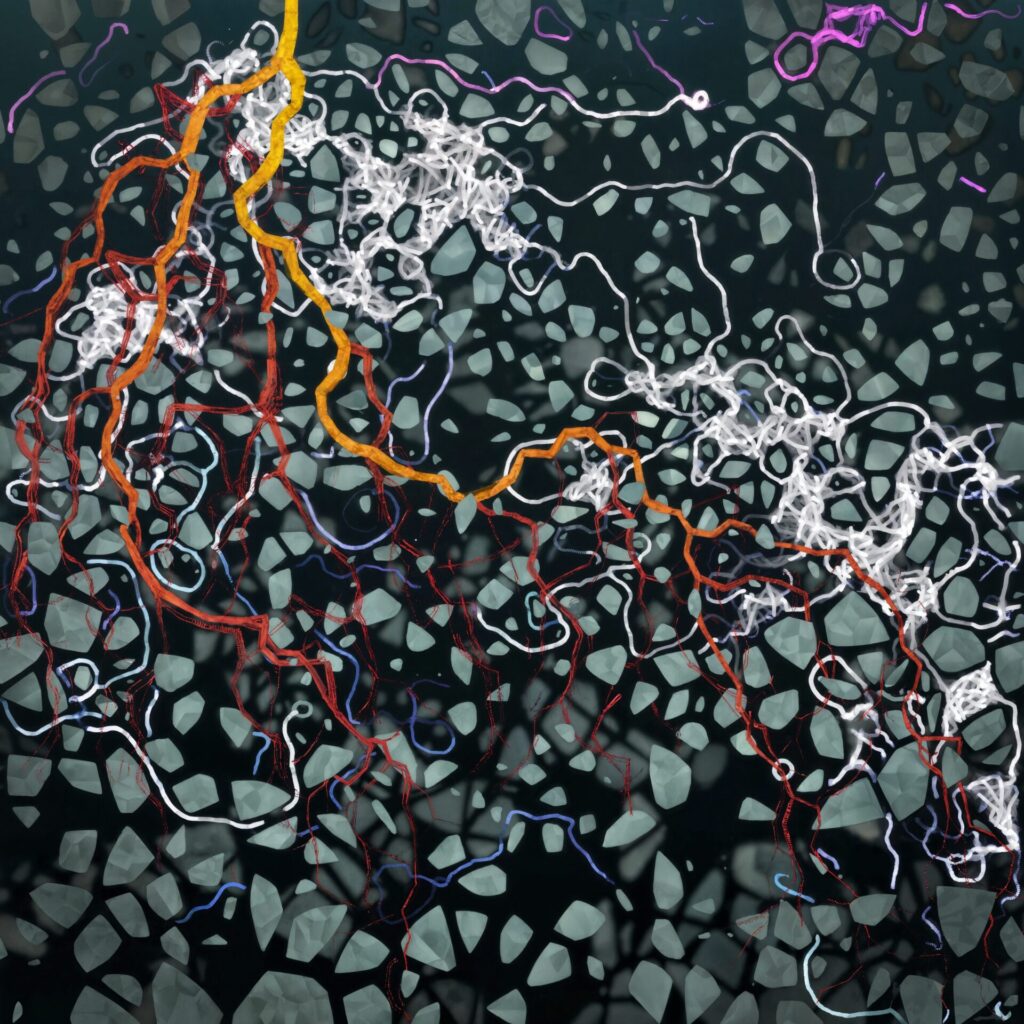
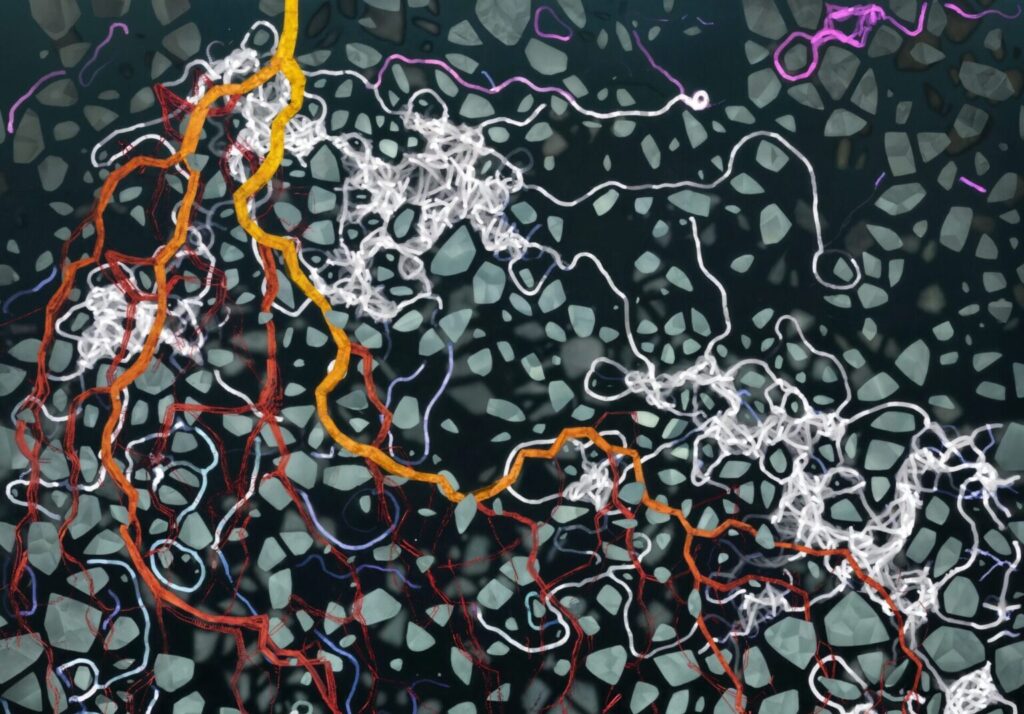
Using algorithmic image and sound synthesis, Rhizosphere makes these hidden connections visible and audible by translating complex biological processes into an immersive audiovisual experience. The simulated organisms grow through the underground ecosystem to access nutrients, and must adapt to stressors such as drought or erosion in order to survive. Information about the state of these virtual organisms and events in their „habitat“ is translated into acoustic signals. These sounds are woven into a soundscape that invites the audience to immerse themselves in the subterranean cosmos. Historical drawings and examples of current research — such as that of SPUN — expand our simulation.
Our goal is to bring the enormous complexity of hidden soil life and its fundamental importance for (the survival of) life on Earth to as broad an audience as possible, in an aesthetically engaging way.
Visualization
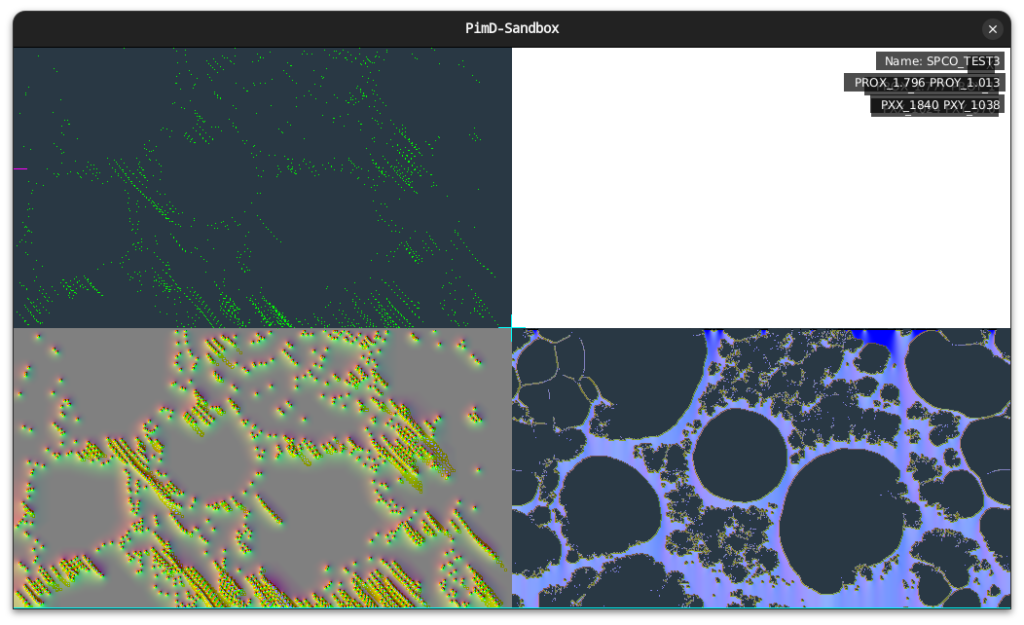
At the heart of the project are algorithms that model biological growth. Our simulation encompasses plant roots, fungal hyphae, and the surrounding soil with its distributions of moisture and nutrients, as well as the mutual influences between these components. We let the roots grow using Space Colonization Algorithms¹ and the hyphae using Slime Mold Simulations².
Space Colonization Algorithms
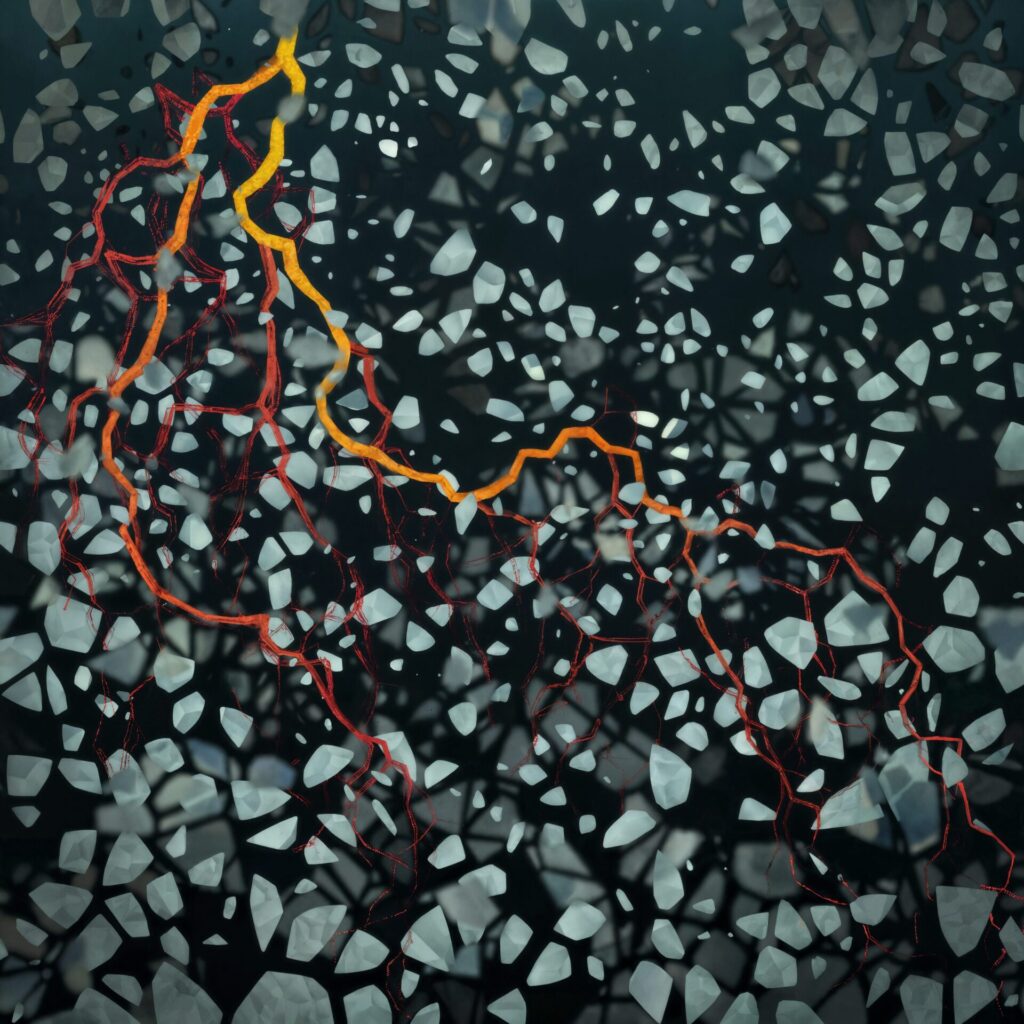
Space Colonization Algorithms model growth that orients itself toward resources in the immediate environment. The starting point is a simple „root embryo“ (the plant’s shoot axis) from which the system branches out step by step. Points distributed throughout the digital soil — sources of water and nutrients — guide the growth by attracting nearby root tips. When a root tip reaches one of these points, the area is considered colonized and loses its influence. Over time, a root network emerges that not only resembles real roots, but also vividly illustrates their search for favorable conditions.
Slime Mold Simulations
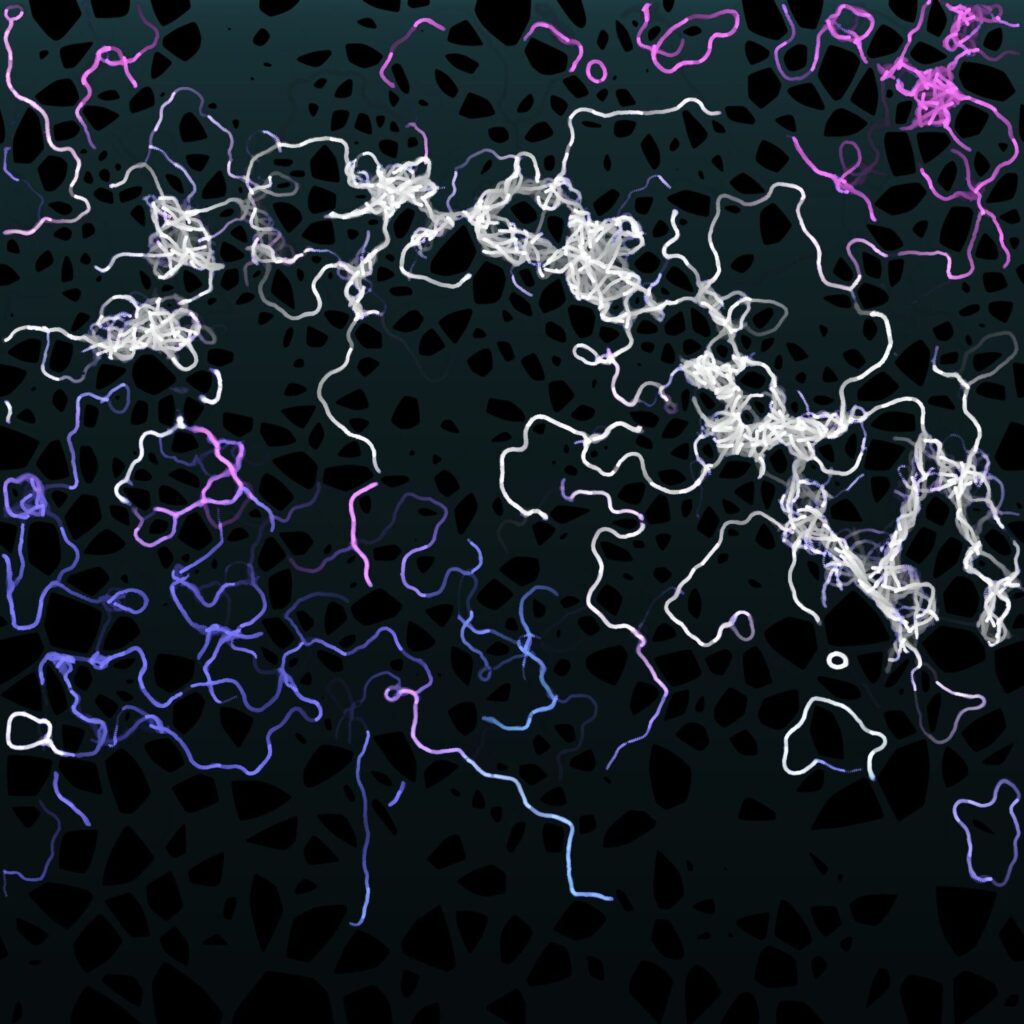
Slime Mold Simulations draw on a different growth principle: they mimic the behavior of slime molds, which respond to stimuli as a swarm-like system. A network of virtual „particles“ moves through space, leaves a trail, and orients itself toward existing trails and food sources. Where many particles travel, the trail is reinforced — the network is stabilized. Less-used connections dissolve over time. In this way, finely branched, efficient conductive structures emerge that are reminiscent of fungal networks, blood vessels, or transport grids.
Soil
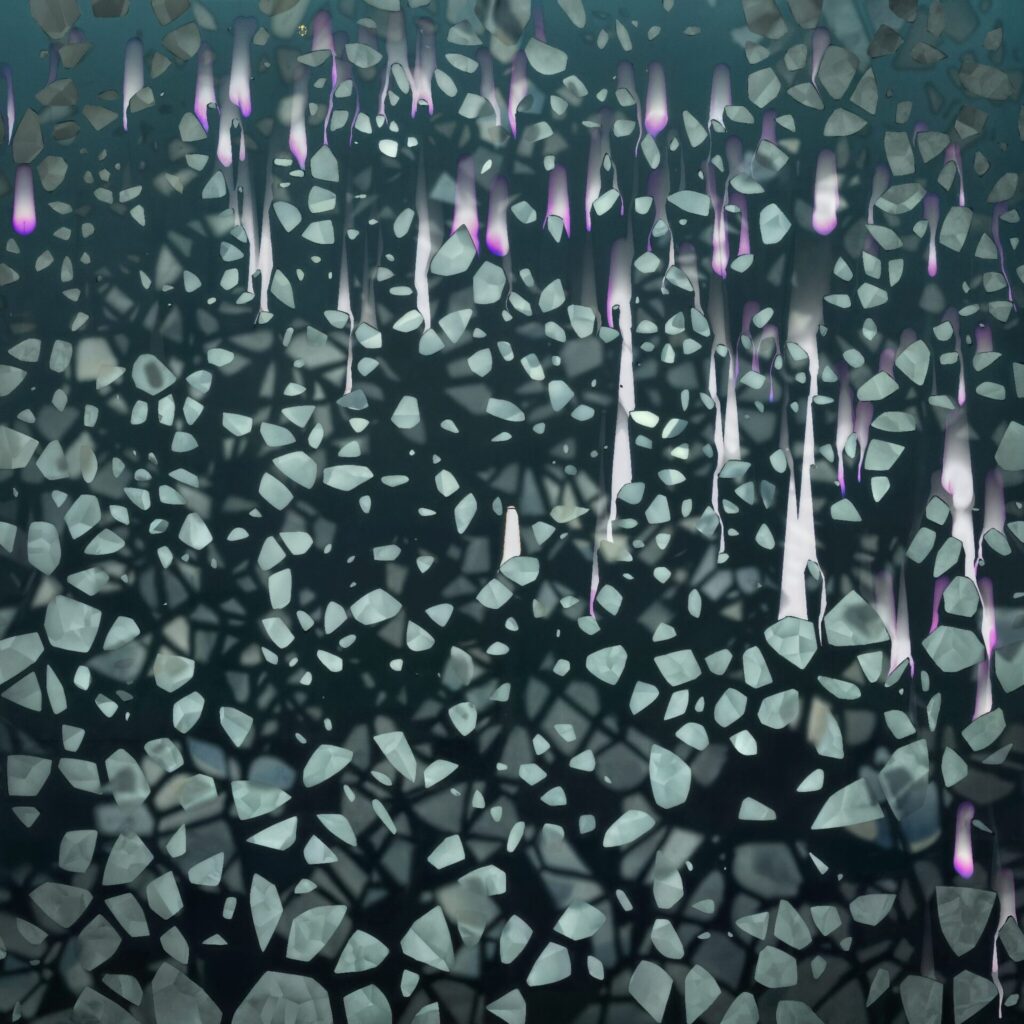
These algorithms act as agents whose particular form depends heavily on the properties of the virtual environment they inhabit. This virtual substrate is given structure through Voronoi Noise³. The distribution of resources then occurs through custom-developed percolation and diffusion algorithms. This produces shifting patterns of nutrient content, moisture, and permeability. These influence the spread of the agents, but are in turn also altered by the agents‘ own colonization. The result is a complex and dynamic world of underground networks.
Voronoi Noise
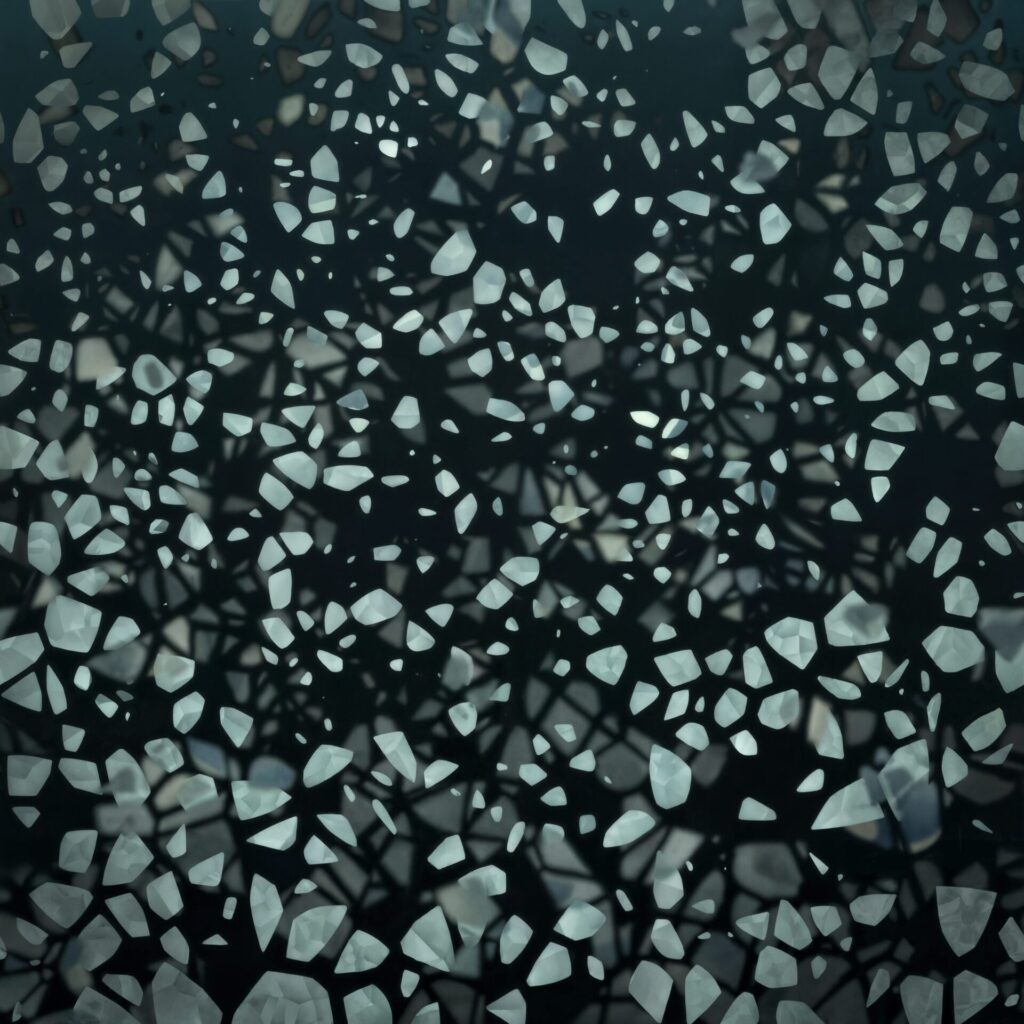
Voronoi Noise provides the fundamental spatial pattern on which all further processes unfold. Starting from a set of distributed seed points, space is divided into zones in which the nearest seed point dominates. This produces polygonal fields whose size and shape depend on the positions of these points, and which are reminiscent of natural cellular structures. By generating these fields with different material properties and random variations, the substrate becomes both structured and heterogeneous. The agents thus encounter an environment with local characteristics to which they respond as they grow.
The virtual substrate plays a central role in the exchange of information between agents. It is therefore ideally suited for artistic intervention. By manipulating the local properties of the substrate, the visual composition and its evolution over time can be influenced without having to specify the details of execution. The artistic input in the running simulations is limited to simple gestures, while the image generation is left to the algorithms.
Sonification
Rhizosphere begins with an above-ground spatial recording of the soundscape of a forest in spring. Just as the gaze dives into the hidden world of the forest floor, so too does the sound.
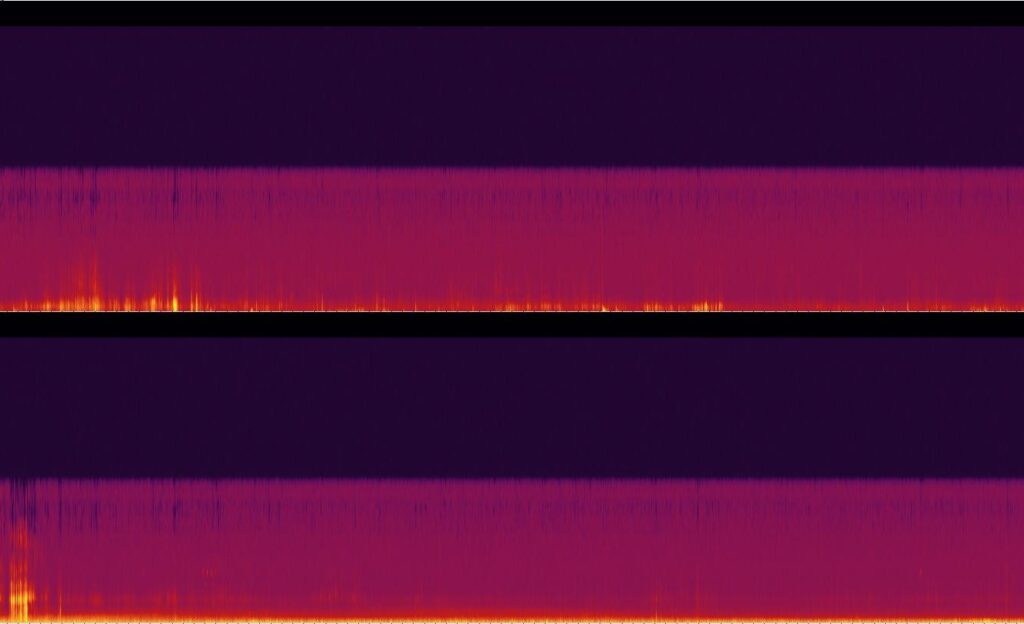
To make audible what is essentially inaudible to our ears — such as the flow of substances or the growth of roots and hyphae — parameters from the aforementioned algorithms, as well as the spatial coordinates of the agents‘ growth, are sent as a continuous data stream to a second computer.
This computer’s task is to translate this data stream into sound (sonification) and, in correspondence with the visualizations, to distribute it spatially (spatialisation). This creates a dynamic soundscape that flows through the space, further abstracting the modeled biological processes and extending their visualization.
The sprouting and growing of roots and hyphae is made audible through microscopic, granular sound events. The flow of water and substances forms further sonic layers. Depending on the progress of the simulations, these layers may condense into shimmering and rushing noise.
The sonic foundation consists of real soil recordings, captured using a device developed as part of the Swiss citizen science project Sounding Soils. The sounds — produced primarily by soil fauna — form, together with the forest recording heard at the beginning, a kind of acoustic frame.
¹ Based on „Space colonization (2D) experiments in JavaScript“ by Jason Webb: jasonwebb.github.io/2d-space-colonization-experiments/
² Based on „Slime-Simulation“ by Sebastian Lague: github.com/SebLague/Slime-Simulation
³ Based on „Cellular Noise“ from The Book of Shaders by Patricio Gonzalez Vivo and Jen Lowe: thebookofshaders.com/12/